


How the Protect College Sports Act could affect college golf
by Golf NIL Staff
October 1, 2026
Three things to know:
The Senate passed it. The House is next.
The bill protects college golf and other non-revenue sports, but schools are not required to use every available opportunity.
The legislation would affect NIL rules, athlete protections, eligibility, and certain Division I program requirements.
The Protect College Sports Act cleared the Senate on Monday, 77-22. Now it moves to the House—and it is still far from becoming law.
The House would need to pass the measure before it could reach the president. If the House changes the Senate’s version, both chambers would need to agree on the same final text.
The bill would set federal rules for NIL, including protections for athletes who sign NIL deals or hire agents. It would require agents to register, limit their fees to 5%, and bar false or misleading claims about NIL opportunities.
There is more in it than NIL. Athletes could not lose scholarships because of injury or athletic performance, and scholarship support would remain available for 10 years after eligibility. Division I schools would also be required to cover certain out-of-pocket costs tied to athletics-related injuries during eligibility and for five years afterward.
It would set a five-year eligibility clock and allow one penalty-free transfer, with exceptions for coaching changes, sport discontinuations, graduate study, and other circumstances.
For golf, the details matter as much as the headline.
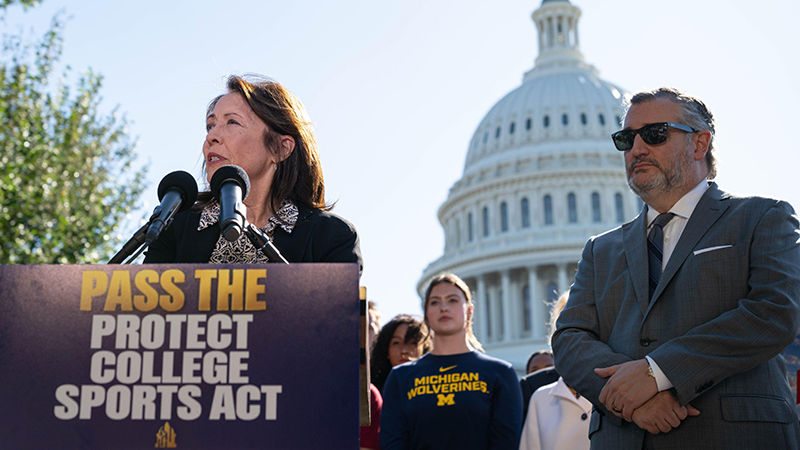
Sens. Maria Cantwell, D-Wash., and Ted Cruz, R-Texas, speak at a Sept. 14 news conference about the Protect College Sports Act | Sipa USA/Alamy Live News
Some of the bill’s most important details are in what schools would be required to protect—and what they would be allowed to do.
The bill would set some minimum protections for college golf and other non-revenue sports, while leaving additional spending decisions to schools.
For Division I schools, the bill would require schools to keep a minimum number of sports. At schools that receive collective media-rights revenue, it would also preserve the overall number of roster spots and scholarships offered in non-revenue sports in 2024-25.
The money side is different. The bill would allow an institution to exceed the revenue-share cap by up to $22.5 million annually through a retention fund. That amount could increase by as much as another $5 million based on qualifying NIL compensation the school provides to athletes in non-revenue-generating sports, including women’s and Olympic sports.
The additional $5 million is tied to qualifying compensation a school provides to athletes in those sports. However, the bill does not require a school to spend more on golfers or other non-revenue athletes.
The retention-fund exception would last nine years and could end sooner if the House settlement expires or terminates without congressional approval to continue it.
The bill also gives athletes a seat in the next round of decisions. The Senate-passed text would require athletes to hold at least one-third of the membership and voting power on certain governing boards and rulemaking committees after enactment.
The Senate vote put the bill in play. The House decides whether it keeps moving.
Passage in the Senate does not guarantee a House vote or final approval, and the legislative calendar is closing. If the measure does not become law before this Congress ends, lawmakers would have to start over in the next Congress.


